
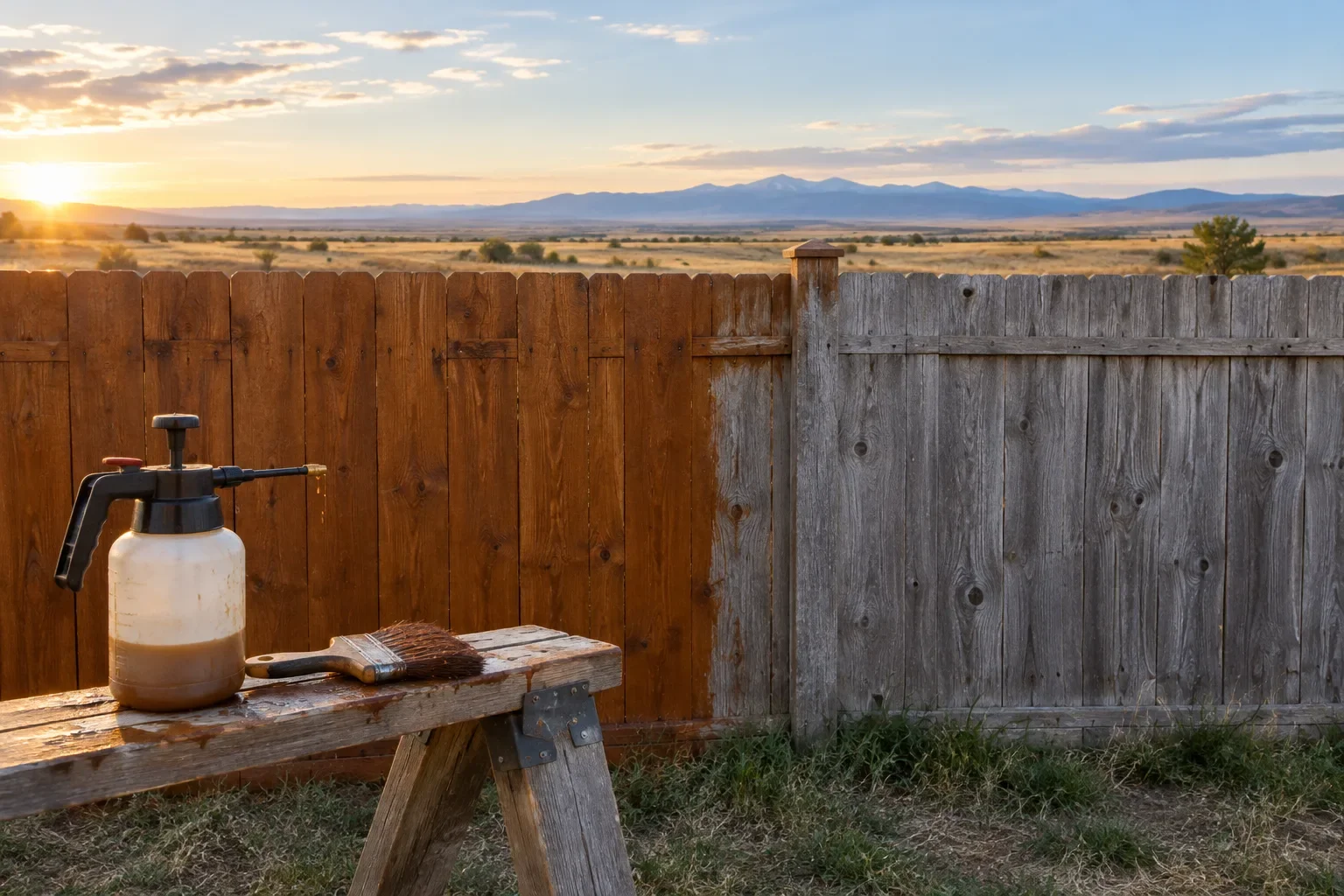
A Windsor home built around the median year of 2009 now has a fence old enough that a fresh coat of stain is probably on the list, and a pump sprayer is the tool most homeowners grab first. Staining a fence with a pump sprayer works best with thin, even coats, a steady hand, and a brush pass right behind the spray. The sprayer puts liquid on the wood quickly. The brush presses it into the grain and smooths out drips before they dry into dark streaks.
This guide covers what a pump sprayer can and cannot do, how to prep the wood and the tool, the spraying pattern that avoids lap marks, and what Northern Colorado wind and sun do to the job. It also covers when it makes more sense to hand the project to a pro like Keystone Painting.
What a pump sprayer can and cannot do on a fence
A hand pump sprayer is a pressurized tank with a wand and an adjustable nozzle. You pump the handle to build pressure, squeeze the trigger, and stain comes out as a fan or cone. It costs far less than a paint sprayer and is easy to clean, which is why it is the default tool for homeowners.
It shines on picket fences, shadowbox fences, lattice, and rails. Those surfaces have gaps and edges that a roller or brush takes forever to reach. The stain goes into the spaces between boards in one pass.
It struggles on long, flat privacy fences in a breeze, and with thick or heavily pigmented stains that clog a small nozzle. A pump sprayer also does not push stain into the wood. It only delivers it. Skip the brush step and you often get a blotchy look, with pooling at the bottom of boards and thin spots higher up.
Prep the wood, the stain, and the sprayer first
Most failed spray jobs are decided before any stain comes out. Three things matter.
The wood. Clean the fence so the stain can soak in. Dirt, mildew, and old flaking finish all block penetration. After washing, let the boards dry fully, because wet wood refuses stain. A moisture meter takes the guessing out. Brand-new wood has its own timing, and the stain label will say whether it should weather first.
The stain. Thin, penetrating stains spray best. Heavy solid-color products are harder to push through a small nozzle. Strain the stain through a paint strainer before it goes in the tank, and stir it rather than shaking it. Wood species matters too, and how cedar takes stain is worth a read if your fence is cedar.
The sprayer. Check the seals and the label before filling it. Oil-based stains and some solvents can wear out standard rubber seals, so use a sprayer rated for your product. Pick one with an adjustable nozzle so you can set a flat fan, and run clean water through it first to test the pattern and catch leaks.
Then protect what you do not want stained. Cover plants, siding, concrete, and anything within reach of mist. Wear a respirator suited to your stain, eye protection, and gloves. Mist drifts farther than you expect.
If that prep list sounds like a long weekend you would rather skip, Keystone Painting offers free on-site quotes for fences and decks.
The spray pattern that avoids runs and lap marks
Once the wood is dry and the sprayer is tested, work in a steady rhythm.
- Start with a test board. Pick a low-visibility spot and check color and spread before committing to the whole fence.
- Work in small sections. Keep the edge wet where one pass meets the next. Stop mid-board and the dry edge shows up as a stripe.
- Hold a consistent distance. Move parallel to the boards and overlap each pass slightly. Arcing your wrist changes the distance and leaves uneven coverage.
- Keep the wand moving. Pausing for even a moment deposits too much stain, which runs and can look glossy or peel later.
- Back-brush right away. Follow the sprayer with a brush along the grain. This evens out the coat, works stain into the wood, and picks up pooling.
- Do both faces if both are visible. A fence that borders two yards looks patchy if one side gets all the attention.
- Do the tops and edges. End grain and board tops soak up the most stain and are where weather gets in first.
Stay on thin coats. Two light coats generally look better and last longer than one heavy one. The stain label gives the wait time between coats.
Staining a fence in Windsor: wind, sun, and aging boards
Windsor sits on the Northern Colorado plains, where afternoon wind is common, the air is dry, and summer sun is strong. All three affect a pump sprayer more than they affect a brush.
Wind is the biggest problem. A breeze carries fine mist onto cars, neighbors' yards, and your own siding, and it makes the spray pattern inconsistent. Early morning is often calmer, though the boards need to be dry of dew by then.
Dry air and direct sun make stain flash off the surface fast. That causes lap marks when a wet edge dries before you reach it. Work in shade, follow the sun around the fence, keep sections small, and check the temperature range on the can.
Fence age is the second local factor. According to the U.S. Census Bureau's 2024 American Community Survey estimates, the median home in Windsor was built in 2009, and 78% of homes are owner-occupied. A fence that came with a typical Windsor house has likely been through well over a decade of weather. Older, thirsty boards soak up stain unevenly, which is one more reason a quick spray with no brush pass tends to look patchy.
If you live in an HOA neighborhood, check color and product rules before you buy anything. Keystone Painting also handles HOA painting, and the Timnath HOA approval project shows a fence staining job in an HOA community.
Frequently Asked Questions
Is it better to brush or spray stains on a fence?
Spraying is faster and brushing gives better penetration, so the best results usually come from doing both. Spray to cover the surface quickly, then back-brush along the grain. Brushing alone is slow on a long fence, and spraying alone can leave uneven coverage, drips, and thin spots where stain did not soak in.
What is the fastest way to apply stain to a fence?
Spraying is the fastest method, and a powered airless sprayer moves quicker than a hand pump unit on a large fence. A pump sprayer still beats a brush on picket or slatted designs. Back-brushing slows you down, but skipping it often costs more time later when you fix blotchy boards.
What is the best pump sprayer for applying fence stains?
Look for features rather than a brand. You want an adjustable nozzle with a flat-fan setting, seals rated for your type of stain, a tank size you can carry comfortably, and a wand long enough to reach without stooping. Check the label for compatibility with oil-based or water-based stain before buying.
How to stain wood with a pump sprayer?
Clean the wood and let it dry, then strain and stir the stain, fill the tank, and test the pattern. Spray a small section in overlapping passes with the nozzle moving, then back-brush along the grain. Repeat section by section, keeping wet edges, and clean the sprayer when you finish.
Can I use a pump sprayer with water-based fence stain?
Yes, as long as the sprayer is rated for it and the stain is thin enough to pass through the nozzle. Strain it first to avoid clogs. Water-based stains are usually easier on equipment and clean up with water, but read the instructions on both the stain and the sprayer.
How do I keep stain off my house and my neighbor's yard?
Spray on calm days, hold the nozzle close to the boards, and cover everything nearby. Place cardboard or plastic behind the section you are spraying as a shield. If the wind picks up, stop and wait. Mist travels farther than it looks, and dried overspray is hard to remove.
When a Windsor fence is better left to Keystone Painting
Staining a fence with a pump sprayer is a manageable weekend project if you pick a calm day, prep the wood, and take the time to back-brush. If the fence is long, the wind will not quit, or you would rather spend the weekend elsewhere, Keystone Painting can take it on. The company is licensed and insured in Colorado, the crew you meet on day one is the crew that finishes the job, and free on-site quotes come with a personal response, usually the same day.
See the fence staining service in Windsor or call Keystone Painting at (970) 670-3965. Hours are Monday to Friday 8am to 5pm and Saturday 9am to 3pm.