Why Most Commercial Painting Buyers Don't Know What They're
Getting Into
If your business or property association has never hired a commercial exterior painter before, the process can feel like a black box. You get a bid, someone shows up with trucks and ladders, and a week later it either looks great or you're already seeing problems.
That's not good enough — especially when you're talking about a significant investment on a building that represents your brand.
This is a walkthrough of how a real commercial exterior painting job actually works, from the first site visit to the final walkthrough. If you're evaluating contractors for a commercial painting project in Fort Collins CO or the surrounding area, this is what a professional process should look like.
Step 1: Site Assessment
Every commercial job starts with a proper site assessment — not just a quick look and a number.
A thorough assessment covers:
- Current surface condition — Are there cracks, peeling, moisture damage, or failed caulking? These need to be documented before any coating conversation starts.
- Substrate type — Stucco, wood siding, metal panels, concrete block, and composite materials all have different prep requirements and coating compatibility.
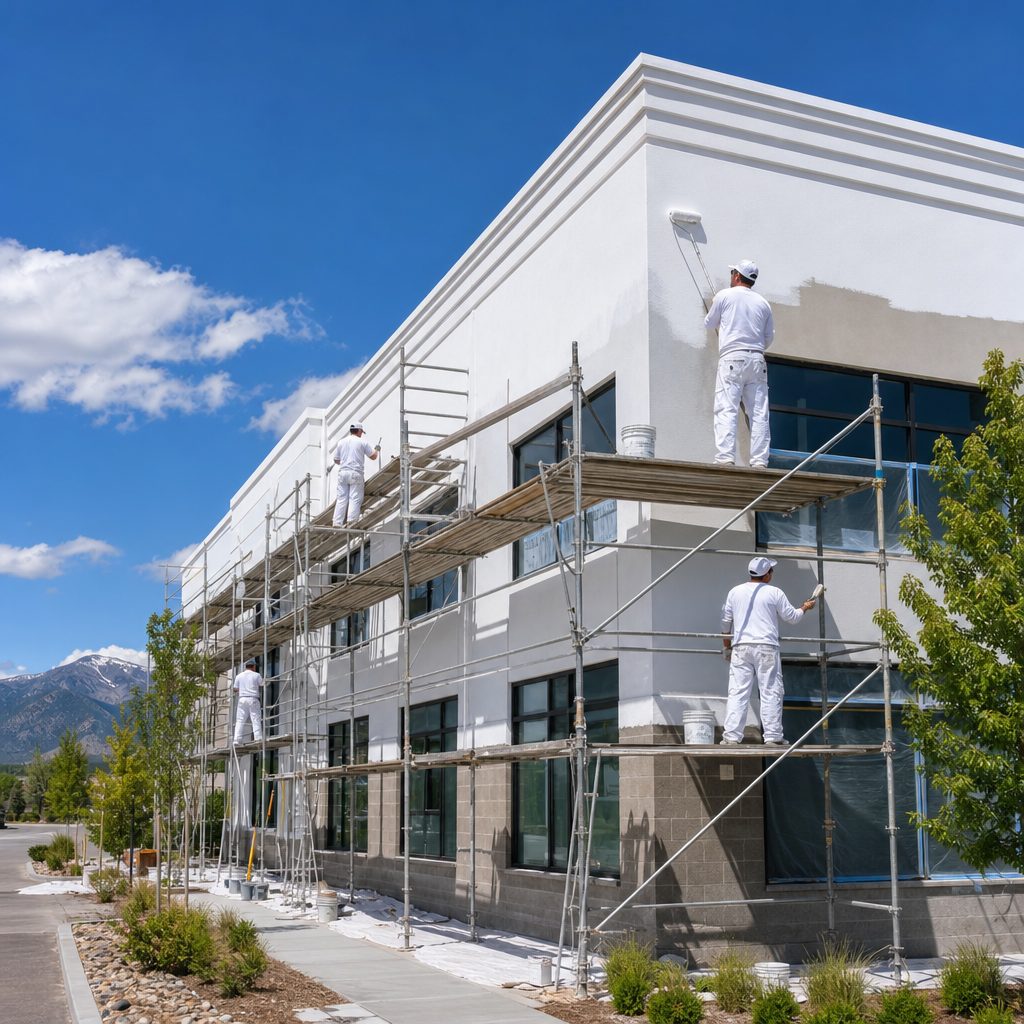
- Accessibility — Does the job require lifts, scaffolding, or special equipment? This affects both timeline and cost.
- Exposure profile — In Northern Colorado, we're dealing with altitude UV intensity 10–15% higher than lower-elevation regions, plus significant freeze-thaw cycling. That affects coating selection.
This is also when a reputable contractor asks about your timeline, any HOA or municipality requirements, and whether phasing the work matters for your tenants or operations.
Step 2: Coatings Specification
Once the site is assessed, the right contractor builds a coatings spec — not just picks a color.
"Spec" means: which primer, which topcoat, how many coats, and why. For commercial exteriors in the Fort Collins area, that usually means:
- A penetrating primer suited to the substrate
- A high-build topcoat with demonstrated UV resistance and flexibility for temperature cycling
- A finish system rated for 7–10 years under real Northern Colorado conditions — not just under controlled lab conditions
This is where experience with the local climate matters. A product that performs well in Houston won't necessarily hold up through a Colorado winter. When you review a bid, ask what system they're specifying and why.
Step 3: Scheduling and Pre-Job Coordination
Commercial painting requires coordination that residential work doesn't. Before a crew ever shows up, a professional contractor should:
- Confirm paint delivery and material staging logistics
- Coordinate with you on crew access hours (especially if tenants are present)
- Pull any required permits
- Notify adjacent businesses or parking areas if work will affect them
- Set up proper signage and safety perimeter
Clear pre-job communication prevents the surprises that cause delays and tenant complaints.
Step 4: Surface Preparation
This is where most of the work actually happens — and where corners get cut by less serious contractors.
Proper surface prep on a commercial exterior typically includes:
- Pressure washing to remove dirt, chalking, mildew, and loose coating
- Scraping and sanding any failing paint back to a stable surface
- Caulking and sealing gaps, joints, and penetrations
- Spot priming bare or repaired areas before full-coat primer
- Masking windows, doors, signage, and any surfaces not being painted
Skipping or rushing this step is the #1 reason paint fails early. A 7–10 year system only delivers if it's applied over properly prepared surfaces.
Step 5: Application
Application sequencing matters. A professional crew follows:
- Full prime coat on all prepared surfaces
- First topcoat applied at spec thickness (check the product data sheet — mil thickness matters)
- Second topcoat (required by most quality systems)
- Detail and trim work completed after field coats
Weather windows matter here too. In Northern Colorado, paint shouldn't be applied below 50°F or above 90°F. Scheduling around temperature and humidity — not just around crew availability — is part of doing the job right.
Step 6: Quality Control Inspection
A professional contractor doesn't just pack up when the last brush stroke is done. Final QC should include:
- Visual inspection of all surfaces for holidays (missed spots), drips, or inadequate coverage
- Touch-up pass to correct any deficiencies
- Walkthrough with the property owner or manager — you should be looking at the finished product together, not receiving a phone call saying it's done
- Documentation of the system applied, colors used, and warranty terms
If a contractor isn't doing a formal closeout walkthrough, that's a yellow flag.
Hiring for a Commercial Painting Job in Fort Collins CO?
Now you know what the process should look like. If a contractor you're evaluating can't speak fluently to each of these steps, that's information worth having before you sign anything.
Keystone Painting handles commercial exterior projects across Fort Collins, Windsor, Timnath, and greater Northern Colorado — with $2M liability coverage, licensed and insured crews, and paint systems built for Colorado's specific climate demands.
Request a free on-site quote and we'll walk your building with you and give you a clear picture of what it needs — no pressure, no guesswork.