Not Just a Bigger House
It's a fair assumption to make: painting is painting. You hire someone with rollers and brushes, they cover the surface, job done. But if you manage or own a commercial property in Fort Collins or Northern Colorado, that assumption can cost you — in downtime, failed coatings, liability exposure, and rework.
Commercial exterior painting is a fundamentally different discipline. The surfaces are different, the coatings are different, the equipment is different, and the project management requirements are in a different category entirely. A contractor who does excellent work on residential homes isn't automatically equipped to handle a commercial job — and the gap between the two shows up fast.
Here's what actually separates commercial and residential exterior painting, and why it matters when you're choosing a contractor.
Crew Size and Scheduling Pressure
Residential painting runs on a crew of two to four people working over a few days. Commercial jobs don't have that luxury.
Commercial properties have operational windows. A retail center can't have scaffolding blocking the entrance on a Saturday. An HOA common building may need to stay functional throughout the work. A multi-unit property has tenants with schedules to respect.
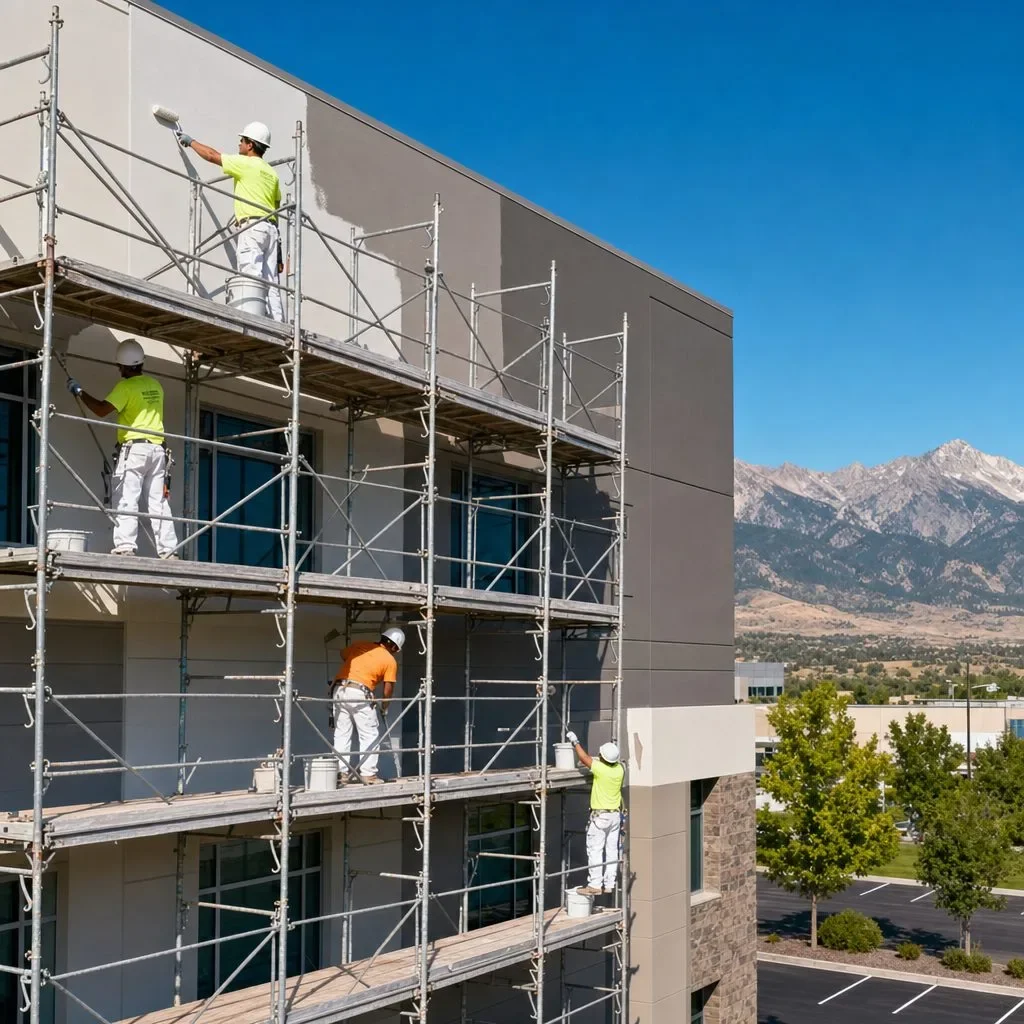
Commercial contractors staff and schedule accordingly — larger crews, phased approaches, and project timelines built around your business operations, not just weather windows. That kind of coordination requires experience. A residential crew dropped into a commercial job typically underestimates the logistical complexity before the first coat goes on.
Equipment Is Not Interchangeable
Residential painters primarily use brush, roller, and small sprayers. Commercial work at scale demands industrial airless sprayers, boom lifts, scaffolding systems, and sometimes aerial equipment — all operated by crews trained to use them safely and efficiently.
Beyond the equipment itself, Northern Colorado's altitude adds a layer of complexity. UV radiation runs 10–15% higher than at lower elevations, and coatings behave differently when applied at elevation and in variable temperature conditions. Commercial crews working in Fort Collins, Windsor, and the surrounding region need to account for these factors in their application approach — not just their paint selection.
Coatings Specs: Commercial Grade vs. Residential Grade
Walk into any paint supplier and you'll find a divide between residential and commercial product lines. The difference isn't just marketing — it's formulation.
Commercial coatings are engineered for higher-traffic surfaces, greater film builds, resistance to impact and abrasion, and longer service intervals. Elastomeric coatings, masonry sealers, and two-part epoxy systems used on commercial substrates don't have a residential equivalent.
At Keystone Painting, our commercial painting systems are specified to perform in Colorado's climate — not just to look good on day one. That means products rated for the freeze-thaw stress this region sees, the UV load at altitude, and the surface types common in commercial construction.
Surface Types Require Different Preparation
Residential exteriors are mostly wood siding, fiber cement, and stucco. Commercial exteriors throw in concrete tilt-up, CMU block, EIFS, metal panel, and brick — often on the same building.
Each surface has a different prep protocol, primer requirement, and coating compatibility. Applying a residential-spec product to a concrete masonry unit won't hold. Skipping proper surface profiling on EIFS leads to adhesion failure. These aren't edge cases — they're the job.
A contractor without commercial surface experience is making it up as they go. That shows up in the finished product, usually within the first year.
Project Management Requirements
Commercial painting projects require documentation, scheduling coordination, safety compliance, and often certificate of insurance requirements that exceed what most residential contractors carry.
Keystone Painting carries $2M in liability coverage — a baseline requirement for most commercial property managers and HOA boards. We're licensed and insured, and we structure commercial projects with the kind of communication and documentation that property managers expect.
If you're evaluating contractors for a commercial exterior painting project in Fort Collins or anywhere in Northern Colorado, ask for their COI before anything else. If they hesitate, that's your answer.
The Right Contractor for the Job
There's nothing wrong with a residential painter who's excellent at what they do. But commercial work has a different set of requirements — crew, equipment, coatings, surface expertise, and project infrastructure — that residential experience doesn't automatically cover.
If you have a commercial property in Fort Collins, Windsor, or the surrounding area that needs exterior work, contact us for a free on-site quote. We'll evaluate the surfaces, specify the right coating system, and give you a realistic project plan built around your operational schedule — not a residential timeline adapted for a commercial job.