That White Powder on Your Siding Has a Name
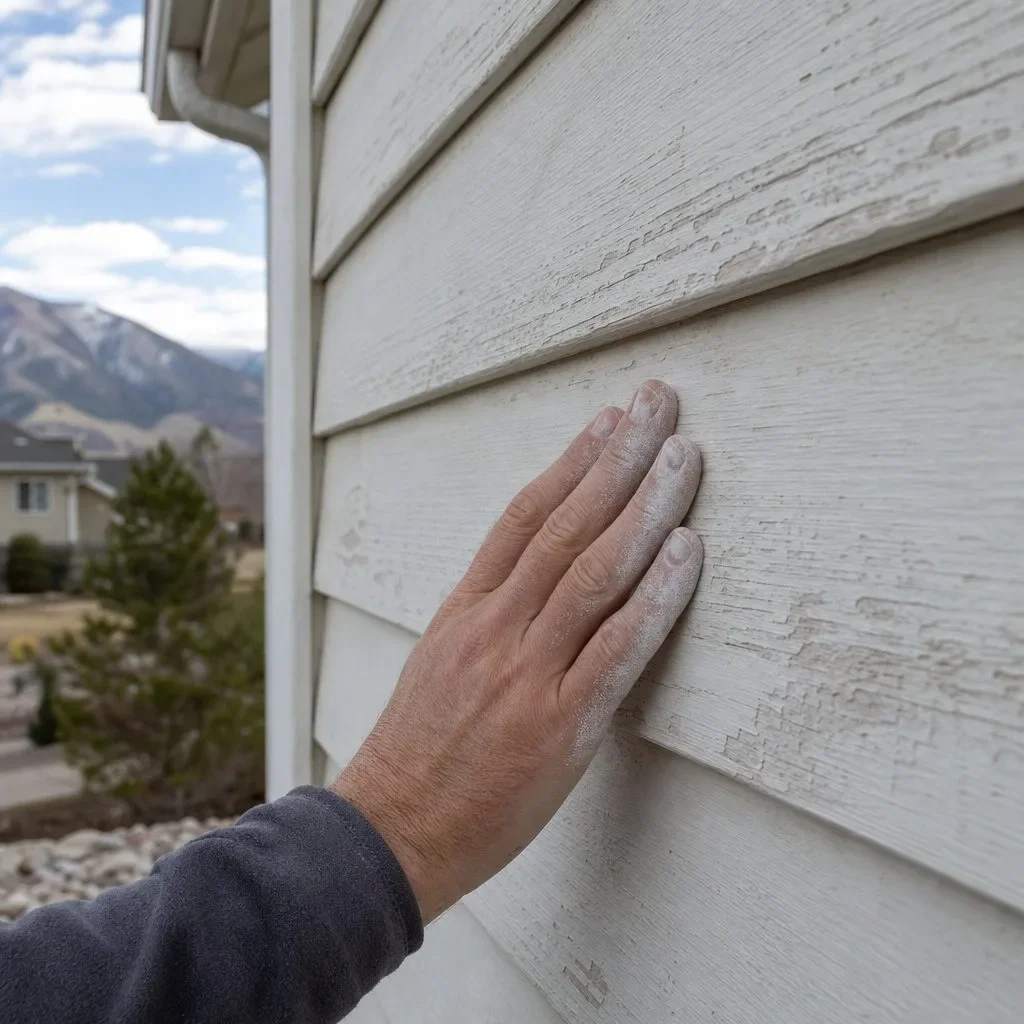
Run your hand across an older painted wall and come away with a chalky white film — that's not just age or grime. It's a specific failure mode called chalking, and it's one of the most common issues we see on homes across Fort Collins, Windsor, and Timnath.
The good news: chalking exterior paint isn't always an emergency. The bad news: if you ignore it long enough — or paint over it without proper prep — you're setting yourself up for a much bigger problem down the road.
Here's what's actually happening, how to know if it's a real issue, and what needs to happen before any new paint goes on.
The Chemistry Behind Chalking (Simplified)
Paint is made of pigment particles bound together in a resin. When UV rays hit the surface over time, they break down that resin through a process called photodegradation. As the binder degrades, it releases the pigment particles — and those particles sit on the surface as a loose, powdery residue.
That powder is the chalk.
At altitude in Northern Colorado, this process accelerates. UV radiation here runs 10–15% higher than lower-elevation regions. Your paint is getting hit harder, faster — which is one reason chalking shows up sooner on homes in Fort Collins and the surrounding area than it would in, say, coastal cities at sea level.
Why Older Homes Chalk More
Homes built before the mid-1990s were often painted with oil-based or alkyd paints that were specifically formulated to chalk as they aged. Manufacturers actually designed this in — chalking was seen as a self-cleaning mechanism, since rain would wash away the chalk layer along with surface dirt.
Modern acrylic latex paints chalk far less aggressively. But even quality modern paint will chalk eventually if it's exposed to enough UV without being maintained. Low-grade paint chalks faster, period — the cheaper the binder, the quicker it breaks down.
How to Test for Chalking
This is the easiest test in home maintenance:
- Run your hand or a dark cloth firmly across the painted surface.
- If you come away with a white, powdery residue — you have chalking.
- Light dusting: normal aging, usually manageable with prep.
- Heavy chalk that transfers heavily and flakes: more significant degradation, needs attention before any repainting.
You can also press tape against the surface and pull it off. If the tape lifts a significant amount of powdery material, that's a sign the paint layer has degraded enough that adhesion of a new coat will be compromised.
When Chalking Is — and Isn't — a
Problem
Not a problem (yet):
- Light chalking on older paint with no cracking, peeling, or adhesion failure
- Uniform chalking across a surface that's still intact and solid
- Minimal chalk on surfaces protected by overhangs or eaves
Time to act:
- Heavy chalking where the surface looks dull, faded, and worn through
- Chalking combined with peeling, bubbling, or bare wood exposure
- Chalk running off onto adjacent surfaces (brick, trim, windows)
- You're approaching or past the 7–10 year mark on the current paint system
Left unchecked, chalking eventually exposes bare substrate — which means moisture intrusion, wood rot, and a much more expensive repair bill than a simple repaint.
Proper Remediation Before Repainting
This is where most DIY repaints go wrong: painting over chalk without removing it first. New paint won't bond to a chalky surface. It'll peel within a season.
Here's the correct process:
1. Pressure wash thoroughly.
A proper pressure wash removes the loose chalk layer. This is non-negotiable. Low pressure won't cut it — you need enough force to actually strip the surface clean.
2. Hand scrub problem areas.
Recessed areas, corners, and trim details don't always get full pressure wash coverage. These need a stiff brush and cleaning solution.
3. Test adhesion after drying.
Run the tape test again after the surface dries. If you're still getting significant transfer, the area needs additional prep or a bonding primer.
4. Apply a high-quality primer.
On heavily chalked surfaces, a penetrating bonding primer locks down the remaining chalk layer and gives the topcoat something solid to grip.
5. Use a quality paint system.
A professional exterior painting application with a high-quality acrylic paint is what actually extends your repaint cycle. Cheap paint applied over proper prep will still fail early — it just fails slower than no prep at all.
Fort Collins Homes Need Paint That Can Handle the Climate
If you're dealing with chalking exterior paint in Fort Collins or anywhere in Northern Colorado, keep in mind that standard paint systems aren't engineered for this region's UV load, freeze-thaw cycling, and dry air. The right paint system for a home here is different than what works in a milder climate.
At Keystone Painting, we spec paint systems designed to last 7–10 years under real Northern Colorado conditions — not just the best-case-scenario numbers on a product data sheet.
Ready to get a real assessment of your exterior? Request a free on-site quote and we'll tell you exactly what your home needs — no guessing, no upselling.